Visions and Missions
The European waterborne sector has developed an ambitious set of missions and visions to be achieved by 2040 and 2050. Their achievement requires a comprehensive, and mission-driven Research and Innovation (R&I) strategy .The R&I Strategy is structured around four pillars. Each pillar addresses a critical transformation area and contributes to Europe’s long-term competitiveness, resilience and sustainability. Across these objectives, cross-cutting priorities include digitalization, sustainability (including circularity), supply chain resilience, standardization, regulatory innovation and workforce transformation.
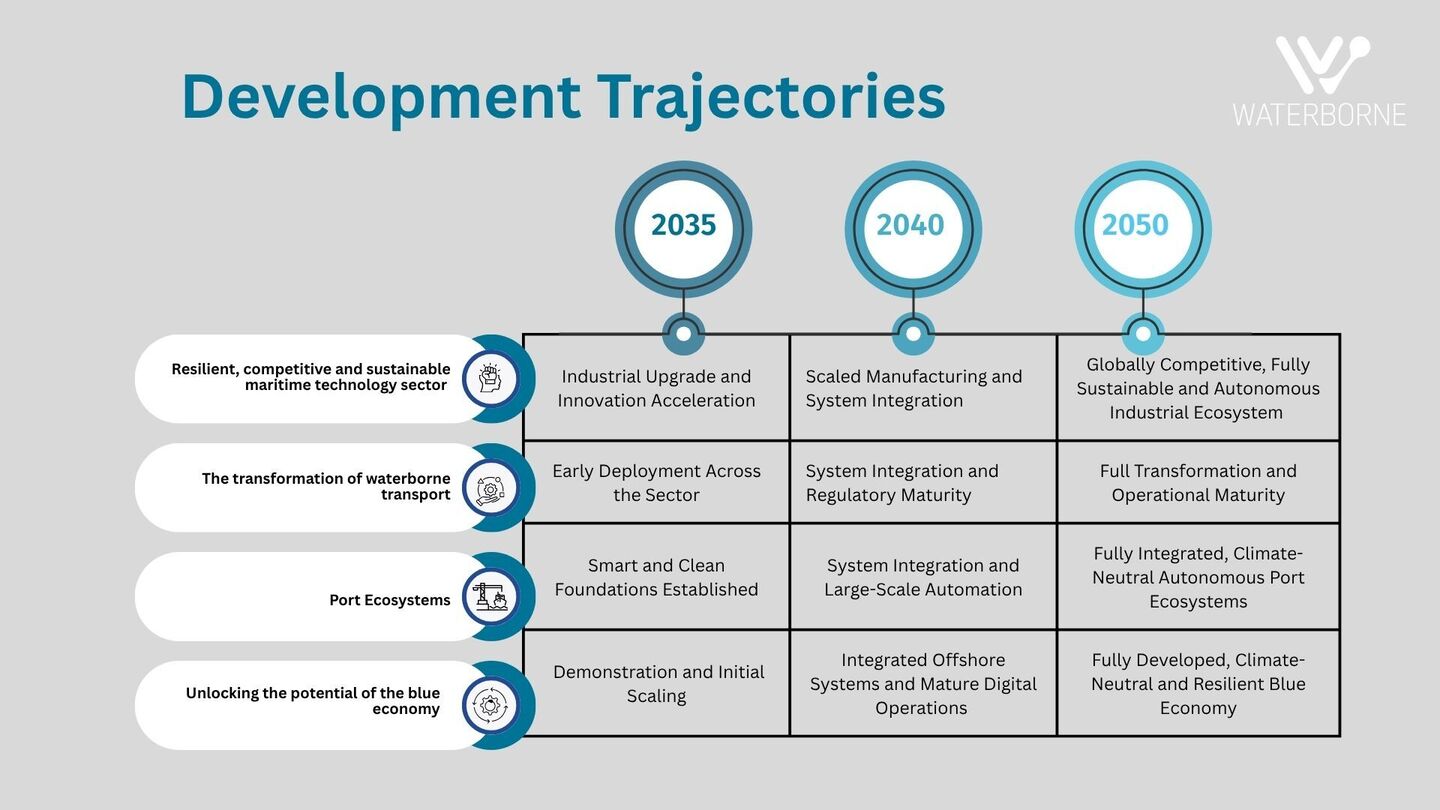
The following sections focus specifically on the Vision and Mission of each pillar, as well as the visual representation of the development trajectories. Other elements of the strategy, such as R&I priorties, development trajectories and expected impacts, are not covered here.
If you are interested in exploring these components in more depth, please refer to the full Technology Leadership document.
Click each pillar to learn more about the missions and visions to be achieved by 2040 and 2050.
| Resilient, competitive and sustainable maritime technology sector |
Vision: The European maritime technology sector, including shipyards and the full manufacturing value chain, will be technology leader in sustainable, digital and competitive manufacturing and deployment by 2050. The maritime technology sector will operate with resilient supply chains, world-class manufacturing capability, high-skilled talent and advanced industrial ecosystems that support zero emission vessels, smart ports, offshore infrastructure, underwater systems and digital waterborne services. Europe will set global standards for innovation, safety and environmental performance, and maintain sovereignty over critical technologies essential to its economic, environmental and security objectives. Mission: This requires a powerful, innovation-driven industrial base capable of designing, manufacturing, retrofitting and maintaining advanced vessels, equipment, systems, components and infrastructures, including technologies with civil, security and defence relevance, contributing to Europe’s preparedness, resilience and strategic autonomy.. If you are interested in exploring the strategy of the maritime technology sector (including R&I priorties, development trajectories and expected impacts) in more depth, please refer to the full Technology Leadership document. |
|---|---|
| The transformation of waterborne transport |
Vision: By 2050, European waterborne transport will be a force of European competitiveness as a safe, secure, and resilient mode of transport, interconnected with European yards, ports and equipment manufacturers, delivering zero harmful emissions, zero pollution and zero fatalities. Operations include a high level of automation and digital intelligence, moving personnel from sea to shore leveraging advancements in remote operations and dual-use vessel technology. Smart integration of vessels, ports and waterways will enable seamless integration into logistics and transport chains, through secure data flows, delivering efficient, predictable and low-impact logistics. The sector will create a market for European value chains delivering energy systems, digital technologies, automation and safe operational practices, backed by regulatory frameworks and standardisation that strengthen Europe’s technological sovereignty, enhance societal well-being and support strategic resilience. Mission: This transformation requires coordinated progress across environmental, technological, industrial, regulatory and social dimensions. It involves eliminating harmful emissions to air and water while ensuring zero fatalities and zero pollution across waterborne operations. Equally important is a human-centred transition. In parallel, regulatory innovation, harmonization and standardization must advance alongside technological progress. If you are interested in exploring the strategy of waterborne transport (including R&I priorties, development trajectories and expected impacts) in more depth, please refer to the full Technology Leadership document. |
| Port Ecosystems |
Vision: By 2050, European ports will be fully integrated, zero-emission, digitally enabled and climate-resilient ecosystems at the heart of global supply chains and Europe’s energy transition. They will function as smart, autonomous and interconnected nodes where vessels, energy systems, logistics, hinterland transport, defence operations and port-city interfaces operate in harmony, driving competitiveness and sustainability for Europe’s waterborne sector and its economy. Mission: This transformation requires ports to evolve from infrastructure providers into a network of active system orchestrators, operating sophisticated digital platforms, enabling alternative fuels, managing real-time logistics flows, and providing secure, climate-resilient services. As critical nodes in global supply chains and energy networks, ports must be able to withstand extreme weather, cyber threats and geopolitical shocks, while enabling efficient, seamless, low-impact operations for both civil and military purposes. If you are interested in exploring the strategy of port ecosystems (including R&I priorties, development trajectories and expected impacts) in more depth, please refer to the full Technology Leadership document. |
| Unlocking the potential of the blue economy |
Vision: By 2050, Europe will be the global leader in the development, operation and maintenance of advanced solutions for the blue economy, ranging from specialized vessels and resilient offshore infrastructure to high-performance underwater systems. The sector will operate through sustainable, digitally integrated and circular business models, supporting climate neutrality, energy independence, economic resilience and security in Europe’s seas, waterways and coastal regions. Mission: The mission is to strengthen Europe’s leadership in the blue economy by developing and deploying innovative, zero-emission, digitally enabled and safe technologies across three core technology domains:
Together, these domains form an integrated technological ecosystem that enables sustainable growth, climate neutrality, economic resilience and maritime security across Europe’s seas, waterways and coastal regions, underpinned by strong European industrial leadership, resilient supply chains, advanced digital tools and a skilled workforce capable of operating in increasingly complex waterborne environments. If you are interested in exploring the strategy of blue economy (including R&I priorties, development trajectories and expected impacts) in more depth, please refer to the full Technology Leadership document. |